Updated 9:29 a.m. Nov. 4 with the latest results.
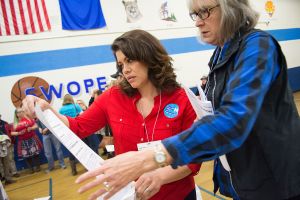
Polls officially closed at 7 p.m. in Nevada, but voters standing in line were encouraged to stay to cast their vote. Once the last voter in line casts their vote, Nevada starts posting results via the Secretary of State’s website.
All eyes were mostly on the state’s governor’s race, which was expected to be among the most competitive not only statewide, but nationwide.
Follow The Nevadan’s live blog as we provide updates regarding key races.
Who won Nevada’s governor’s race?
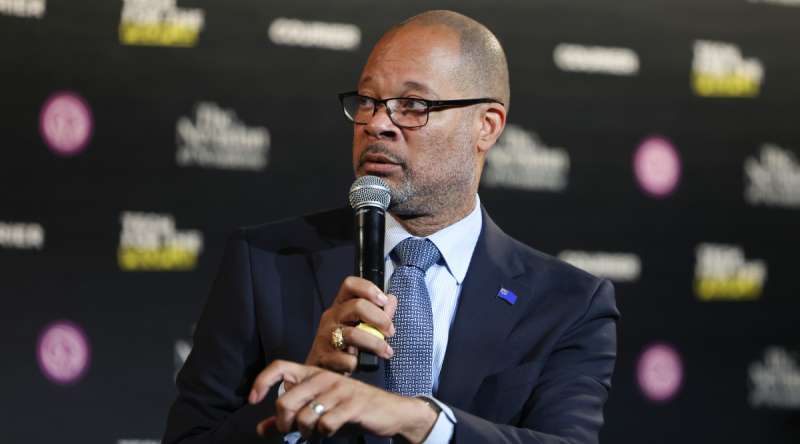
Democratic Attorney General Aaron Ford defeated Republican Gov. Joe Lombardo 51.7% to 44.2%, according to the Associated Press, which called the race at 4:46 a.m. Wednesday.
“Tonight’s victory belongs to the housekeepers, nurses, teachers, rideshare drivers, electricians, and all working Nevadans who will no longer have to settle for working harder than ever,” Ford’s communications director Tai Simmons said in a statement. “Ford will be a Governor for the entirety of the Nevada family and will work tirelessly to build a Nevada in which every person has the opportunity to achieve their American Dream.”
The context carried historic implications: a Ford victory would make him Nevada’s first black governor—and the first black governor west of the Mississippi. Only three Black Americans have ever been elected governor in the US. The last Democrat to unseat a sitting Republican governor in Nevada was Richard Bryan, who defeated Gov. Robert List in 1982.
Ford ran on one key issue: affordability. He pledged to sign a slew of bills aimed at helping working families that Lombardo vetoed during the 2025 legislative session, including universal free school meals, expanded paid family leave, and capping insulin at $35.
Once the secretary of state’s office certified the results, Ford will be sworn into office the first Monday of January, per Nevada law.
Lombardo ran on public safety and education. His campaign touted his tough-on-crime record, with his affiliated PACs tying his crime bill to decrease violent crime statistics in the state. The statistics used, however, were before Lombardo’s crime bill took effect.
Nevada Democrats also tried to tie Lombardo to President Donald Trump, calling it the “Lombardo-Trump economy.”
The two split on almost every major issue, including how to manage data centers and Flock cameras.
Ford will take office in January once results are certified.
Did Democrats flip Nevada’s 2nd District?
Democrat Teresa Benitez-Thompson, a former Reno assemblywoman, defeated Republican David Flippo 51% to 44%, according to The Associated Press, which called the race at 7:35 a.m. local time Wednesday. She will be the first Democrat to represent the Northern Nevada district.
The seat opened when Republican Rep. Mark Amodei retired after 15 years. Amodei refused to endorse Flippo and told CNN he didn’t vote for him, saying he “represents fraud and misrepresentation and not being honest or respecting voters or the process.”
The Washoe County Republican Party responded with a resolution saying it no longer recognizes Amodei as a Republican.
Since Flippo’s announcement to run for CD2, he’s been embroiled in a bed of controversies.
Benitez-Thompson campaigned on affordability and pushing back on the Trump administration. Democrats spent millions in the conservative district.
Did Susie Lee hold Nevada’s 3rd District?
Rep. Susie Lee (D-Las Vegas) won reelection, defeating Republican Marty O’Donnell 59.1% to 38.6%, according to The Associated Press, which called the race at 4:04 a.m. Wednesday.
The southwest Las Vegas district is the most competitive congressional seat in Nevada, but in early October, The Cook Political Report shifted the seat from “lean Democrat” to “likely Democrat.” Trump carried it by about 1 point in 2024 even as Lee won reelection by under 3 points.
Lee, first elected in 2018, describes herself as a centrist Democrat and campaigned on affordability and pushing back on the Trump administration. She’s been named as the most bipartisan lawmaker by the Common Ground Committee.
O’Donnell, a video game composer known for the “Halo” soundtrack, campaigned on restoring the American Dream, securing the border and building a “resilient” economy.
Question 6: Constitutional right to abortion
Question 6 passed in Nevada, according to Decision Desk HQ. The measure, which will enshrine reproductive freedom into Nevada’s constitution, currently has 63.3% support from Nevada voters, with only 36.6% voting against it, with 85% of the votes counted.
Nevadans voted for the second and last time for this initiative that would codify abortion up to 24 weeks of pregnancy into the state’s constitution. The measure passed in 2024 with about 64% of the vote.
It reappeared on this year’s ballot because it must pass in two consecutive general elections for the Nevada constitution to be amended.
The effort followed the U.S. Supreme Court’s 2022 overturn of Roe v. Wade. Once the right to an abortion was nationally overturned, a wave of conservative states began enacting stricter abortion laws—and in some cases, total abortion bans.
Question 7: Voter identification initiative
Question 7 passed in Nevada, according to Decision Desk HQ. The measure, which will amend Nevada’s constitution to require voter ID in all future elections, currently has 62.3% support from Nevada voters, with only 37.7% voting against it, with 86% of the votes counted.
Like Question 6, this measure reappeared on this year’s ballot because it must pass two consecutive general elections. Constitutional adoption requires approval in two consecutive general elections.
Under the amendment, voters casting a ballot in person must present a valid government-issued photo ID, while those voting by mail must provide the last four digits of their driver’s license or Social Security number.
The measure drew strong backing from Gov. Joe Lombardo and President Donald Trump as part of a national push among Republicans for stricter voter ID laws. Advocates believe the initiative would restore trust in election administration.
Nevada, however, already ranks second in election administration, according to MIT’s
Opponents argued that the mandate creates unnecessary hurdles for voters of color, students, and seniors, pointing out that Nevada already ranked second in the nation in election administration on the MIT Elections Performance Index.